
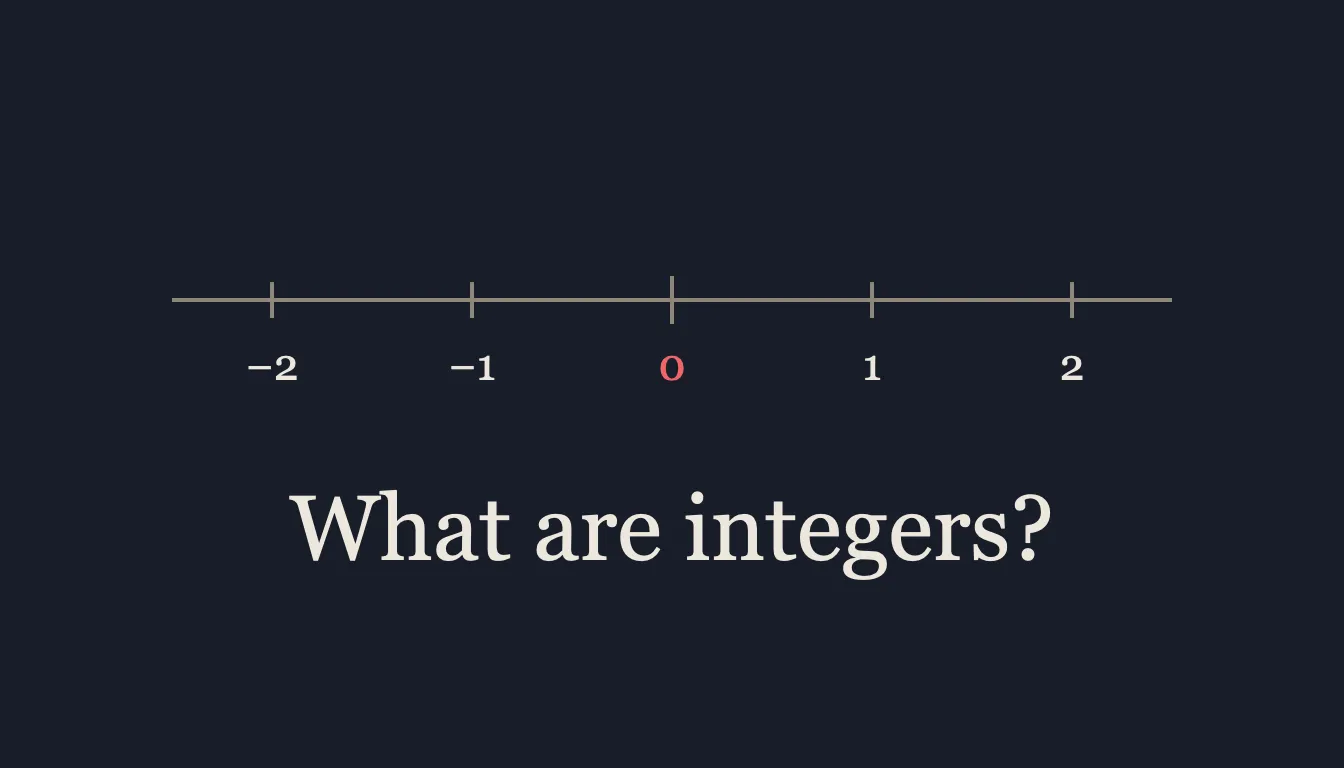
Integers are a foundational concept in mathematics. Anyone who studies math or uses numbers day to day is almost certainly using integers. As an extremely versatile subset of the real number system, integers are used in many different areas of study. In this post, we'll look at what integers are, their properties, and how they are used in real-world applications.
What are integers?
Integers are whole numbers that can be positive, negative, or zero. They are a subset of the real number system and are used to represent quantities such as counts, temperatures, distances, and more. Some examples of integers are −3, 0, and 5.
Properties of integers
Integers have several important properties that are useful in mathematical operations:
- Closure: The sum or product of two integers is always an integer.
- Commutativity: The order in which integers are added or multiplied does not affect the result. For example, 2 + 3 = 3 + 2.
- Associativity: The grouping of integers does not affect the result of addition or multiplication. For example, (2 + 3) + 4 = 2 + (3 + 4).
- Identity: 0 is the additive identity and 1 is the multiplicative identity.
- Additive inverses: Every integer has an opposite that adds with it to make zero; for example, 5 + (−5) = 0. Multiplicative inverses (reciprocals) are a different story: apart from 1 and −1, the reciprocal of an integer, such as ½, is not an integer.
Applications of integers
Integers have numerous real-world applications across a diverse array of disciplines. Here are some examples:
- Temperature: Temperatures are often reported as integers on the Celsius, Fahrenheit, and Kelvin scales. Water freezes at 0 degrees Celsius and boils at 100; in Fahrenheit, it freezes at 32 degrees and boils at 212.
- Finance: Positive numbers represent deposits or gains, while negative numbers represent withdrawals or losses.
- Distance: Integers describe distances in many contexts, such as the miles between two cities or the number of steps taken in a day.
- Sports: Scores and points are integers. In basketball, every basket adds a whole number of points, and the team with the most points at the end of the game wins.
Integers are a basic concept in mathematics with many applications in the real world. By understanding their properties and uses, we can better appreciate how often we rely on them, even without much thought. Whether you're a student just meeting integers or an experienced mathematician, a solid understanding of this foundational idea is essential.